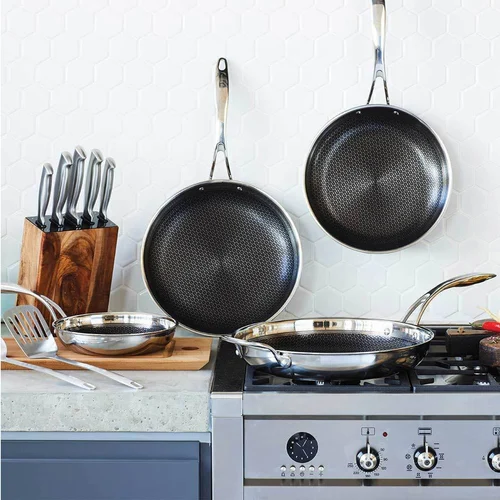
The Best Nonstick Pans for Everyday Cooking
A good nonstick pan should make cooking feel almost effortless.
Eggs should slide from the pan without leaving a stubborn film behind. Pancakes should release with a gentle nudge of the spatula. Fish shouldn’t require you to negotiate with the cookware before dinner. And when you’re finished, cleanup should take about as long as it takes to put the leftovers away.
That’s the appeal of nonstick cookware. It isn’t about replacing every pan in your kitchen. It’s about having one dependable piece of cookware for the foods that are most likely to stick—and the weeknight meals when you simply don’t want another battle at the stove.
But not all nonstick pans are created equal. Some heat beautifully but feel awkward in the hand. Some have spectacular release when new but lose it surprisingly quickly. Others cost considerably more without making everyday cooking meaningfully better.
After looking at the strongest options across traditional and ceramic nonstick cookware, these are the pans we’d consider for an everyday kitchen.
Our Picks
Best overall: Tramontina Professional Nonstick
Best ceramic: GreenPan Valencia Pro
Best for delicate foods: OXO Good Grips Nonstick
Best budget: Tefal/T-fal
Best premium: Made In CeramiClad
Best Overall: Tramontina Professional Nonstick
There is something refreshing about a pan that simply does its job.
Tramontina’s Professional nonstick cookware has earned a reputation for doing exactly that. It doesn’t try to turn a frying pan into a luxury object. Instead, it focuses on the things that matter when you’re actually standing at the stove: good food release, comfortable handling, sensible weight and a price that doesn’t make you hesitate before using it.
It’s particularly good at the foods people buy nonstick pans for in the first place—eggs, pancakes, sautéed vegetables, delicate fish and quick weeknight meals.
The pan also makes a strong case for not overthinking cookware. You don’t necessarily need a beautifully machined, triple-layered, four-hundred-dollar skillet to make a good omelet.
Sometimes the pan that quietly performs every morning is the better purchase.
Why we like it: Excellent everyday performance without a premium price.
Best for: Almost anyone looking for a single everyday nonstick pan.
Best Ceramic Nonstick: GreenPan Valencia Pro
Ceramic nonstick cookware has become increasingly popular among cooks who want a different alternative to conventional PTFE coatings, and GreenPan has been one of the most recognizable names in the category.
The Valencia Pro is a particularly polished example.
It has the slick cooking surface you’d expect from a modern nonstick pan, along with induction compatibility and an oven-safe design. More importantly, it feels like a pan designed for someone who actually cooks rather than simply wants attractive cookware sitting on a shelf.
It’s excellent for eggs and other delicate foods, and its relatively broad cooking surface makes it useful beyond breakfast.
The caveat is one worth understanding before buying any ceramic nonstick pan: excellent release performance when new doesn’t necessarily translate into decades of nonstick performance. Ceramic coatings can gradually lose some of their slickness with use.
That’s not a reason to avoid the Valencia Pro. It’s simply part of the trade-off.
Why we like it: A refined ceramic option with excellent everyday performance.
Best for: Cooks specifically looking for ceramic, PFAS-free nonstick cookware.
Best for Eggs and Delicate Foods: OXO Good Grips Nonstick
If your idea of a perfect breakfast involves eggs sliding around a pan like they’re on ice, OXO deserves a look.
The Good Grips nonstick frying pan combines reliable food release with a comfortable handle and a generously sized cooking surface. It’s the sort of cookware that disappears into your routine—which is exactly what you want from a daily-use pan.
Eggs, omelets and pancakes are obvious applications, but the same qualities make it useful for fish and other delicate ingredients that don’t appreciate being scraped aggressively from the cooking surface.
OXO also gets the ergonomics right. A pan can have an excellent coating and still be unpleasant to use if the handle is awkward or the weight feels wrong.
This one is designed to be picked up, tilted and maneuvered repeatedly without feeling like a chore.
Why we like it: Excellent food release and particularly comfortable handling.
Best for: Eggs, pancakes, fish and other delicate foods.
Best Budget Pick: Tefal/T-fal
Not every good pan needs to be an investment.
Tefal, known as T-fal in some markets, has spent decades making nonstick cookware accessible, and its budget-oriented pans remain compelling for anyone who wants reliable everyday performance without spending heavily.
The better models typically offer reinforced nonstick surfaces and practical features such as heat indicators.
They’re particularly useful for first kitchens, students, rental apartments and anyone who would rather spend money on the ingredients going into the pan.
There is, of course, a reason these pans cost less than premium cookware. Construction and longevity may not match the best high-end alternatives.
But that’s not necessarily a problem.
If you’re paying a modest price for a pan that performs well for years and you’re comfortable replacing it when the coating eventually wears out, the economics can make perfect sense.
Why we like it: Straightforward performance at a very approachable price.
Best for: Budget-conscious cooks and first kitchens.
Best Premium Option: Made In CeramiClad
Premium cookware has to answer a difficult question:
What exactly are you getting for the extra money?
Made In’s CeramiClad makes a reasonably strong case.
Rather than feeling like a disposable nonstick skillet, it has the heft and construction associated with more expensive cookware while retaining the convenience that makes nonstick attractive in the first place.
It’s the kind of pan that makes sense for someone who spends a lot of time cooking and cares about the physical experience of using their cookware—not just whether an egg sticks.
But premium doesn’t mean indestructible.
The coating will still eventually wear, and the price is difficult to justify if all you want is a pan for Sunday-morning scrambled eggs.
For enthusiastic home cooks, though, the combination of construction, performance and design makes it one of the more interesting premium choices.
Why we like it: Premium construction without abandoning the convenience of nonstick cooking.
Best for: Serious home cooks who are willing to spend more.
What Size Nonstick Pan Should You Buy?
If you’re buying just one, we’d generally choose a 10-inch or 12-inch pan.
A 10-inch skillet is wonderfully versatile. It’s large enough for a couple of portions without becoming cumbersome, and it’s especially good for eggs, omelets, vegetables and smaller cuts of meat.
A 12-inch pan gives you more room to work. That’s useful when you’re cooking for a family, browning several pieces of food at once or making a stir-fry where overcrowding would otherwise become a problem.
The difference sounds small on paper. At the stove, it’s surprisingly noticeable.
Choose 8 inches if:
You primarily cook for one and want something compact for eggs and small portions.
Choose 10 inches if:
You want the most versatile size for everyday cooking.
Choose 12 inches if:
You regularly cook for several people or prefer having plenty of room in the pan.
If you’re uncertain, 10 inches is the safest all-purpose choice.
Ceramic or Traditional Nonstick?
This is where shopping for a nonstick pan gets slightly more complicated.
Traditional nonstick cookware typically uses a PTFE-based coating. Its greatest strength is its extraordinary slickness. Few surfaces are better at releasing eggs, pancakes and other delicate foods.
Ceramic nonstick cookware uses a different type of coating and is particularly attractive to shoppers looking for PFAS-free cookware.
Neither is automatically “better.”
Traditional nonstick tends to excel at long-term slickness and affordability. Ceramic cookware can be appealing for its coating chemistry and often has a particularly attractive finish, but its nonstick performance can diminish sooner depending on how it’s used.
Your cooking habits matter almost as much as the coating.
The Secret to Making a Nonstick Pan Last
Nonstick cookware has one unavoidable weakness: the coating is the part that eventually wears out.
You can, however, make its useful life considerably longer.
Keep the heat moderate
Nonstick pans are designed to make food release easy, not to withstand the kind of extreme heat you’d use for aggressively searing a steak in cast iron.
For most everyday cooking, medium or medium-low heat is plenty.
Use the right utensils
Wood and silicone utensils are the safest choices.
Even when a manufacturer says its coating can tolerate metal utensils, there’s little reason to test that claim when a silicone spatula costs very little.
Don’t turn the pan into a storage container
Cook, serve, wash and put it away.
Leaving food sitting in the pan for hours isn’t going to improve the coating, and stacking other cookware directly inside it can cause unnecessary scratches.
Wash gently
Most nonstick pans don’t need aggressive scrubbing. A soft sponge, warm water and dish soap are generally enough.
And if you can hand-wash the pan, that’s preferable to repeatedly sending it through an abrasive dishwasher cycle.
Do You Really Need an Expensive Nonstick Pan?
Probably not.
That’s one of the most important things to understand before buying cookware.
A premium nonstick pan can have better construction, a more comfortable handle and superior heat distribution. Those differences can matter to someone who cooks frequently.
But the difference between a good $40 pan and a $150 pan isn’t necessarily the difference between good food and bad food.
For eggs, pancakes and everyday sautéing, a well-made midrange pan can be remarkably good.
I’d rather see a home cook buy a good $40–$60 nonstick pan and spend the remaining money on a good chef’s knife, cutting board or stainless-steel skillet than spend their entire cookware budget chasing the most expensive nonstick coating available.
How We Think About Nonstick Cookware
There’s a tendency to judge cookware by specifications.
How many layers does it have?
How high is the oven-safe temperature?
Is the base aluminum?
Is it dishwasher-safe?
Does it work on induction?
Those things matter.
But they’re not the whole story.
A genuinely good everyday pan should make you want to use it.
It should feel balanced when you pick it up. The handle shouldn’t get in your way. Food should release without a fight. The cooking surface should be large enough for what you’re making. And cleaning it should be almost boring.
That’s the standard we think matters most.
The Bottom Line
If we were putting together a kitchen from scratch, we wouldn’t buy five nonstick pans.
We’d buy one good one.
For most cooks, the Tramontina Professional is the easiest recommendation because it delivers the fundamentals without asking you to spend a fortune.
If ceramic cookware is your priority, the GreenPan Valencia Pro is a compelling alternative.
For breakfast-heavy cooking and delicate foods, OXO is an excellent choice.
And if you’re building a premium kitchen and don’t mind spending more, Made In’s CeramiClad is where we’d look.
The perfect nonstick pan isn’t necessarily the most expensive one or the one with the longest list of features.
It’s the one you reach for on a Tuesday night without thinking about it.
That’s what good cookware is supposed to do.